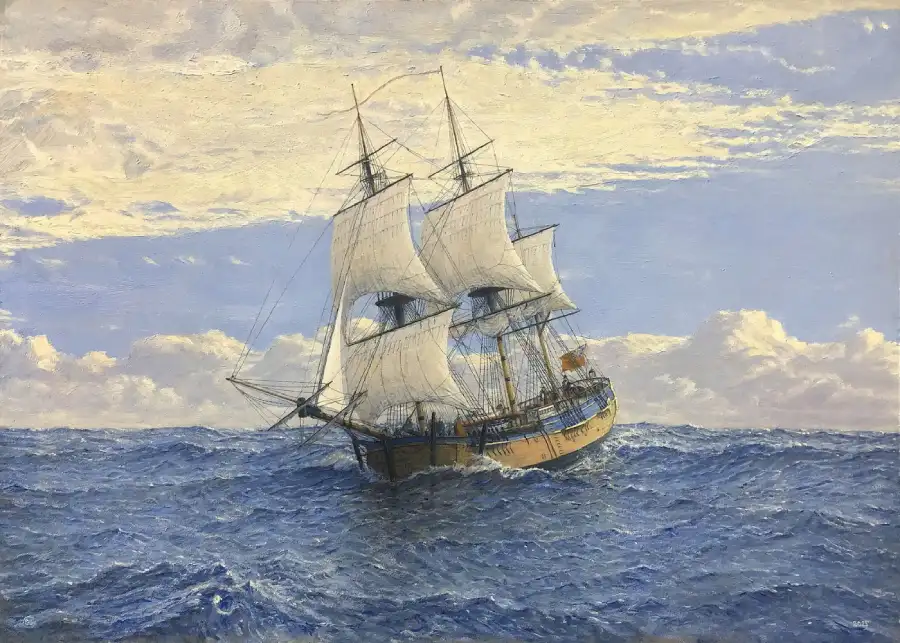
Marine art has a unique combination of technical drawing for the ship, and imaginative creation for the landscape, that not many genres of painting have to handle.
I started out in painting after seeing Geoff Hunt's covers for the novels by Patrick O'Brian that are set in the Royal Navy during the Napoleonic Wars (1803–1815). Initially, I copied his work, and then took a drawing workshop he hosted at an exhibition held by the Royal Society of Marine Artists (RSMA). It was a strong base to me being otherwise self-taught.
I did take a one-year foundation course in Fine Art, but it turned out largely to involve throwing paint at the nearest wall, in the few instances that paint was involved at all. Afterwards I moved professionally into computer generated imagery (CGI) while still painting on the side. Eventually, I started having work accepted into the RSMA shows. I went full-time as a painter at the start of 2026.
Why Exploration
Exploration subjects in particular are something that I have kept returning to. I started with a series of paintings of exploration ships against various exotic landscapes at the end of last year. On a wintery grey day in central Southampton, with ships' foghorns mournfully filling my flat every few minutes, it is very appealing to get a little lost offshore by a far distant island.
I am also drawn in by the narrative of very long travel, often isolated or in a pair of tiny vessels, without really knowing what they might run into, with rudimentary equipment, and being one error away from disaster. The motivations behind the travels are so varied across the famous figures of exploration, ranging from the drive and aggression of 16th-century Francis Drake to the committed professionalism of the 18th-century James Cook.
Reading Cook
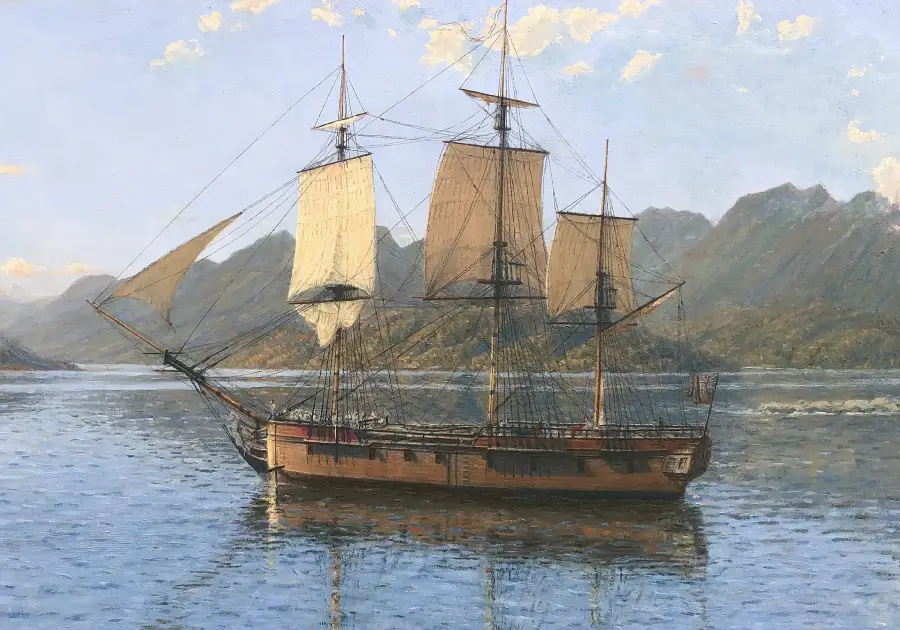
The first book I read about Captain Cook were his journals as published by Penguin Classics.1 On a friend's recommendation I bought a copy of Vanessa Collingridge's biography.2 Soon, I was rather more absorbed than I was expecting. From the cultures and places encountered to the dynamics and figures aboard the ships — especially between Cook and Joseph Banks — it is quite the narrative.
Researching the Ships
Researching the specifics for the paintings of Cook's voyages is mixed. Endeavour is fairly straightforward by the standards of historic vessels, as most questions are readily answered by reference to the excellent replica vessel. But Resolution is harder to pin down.
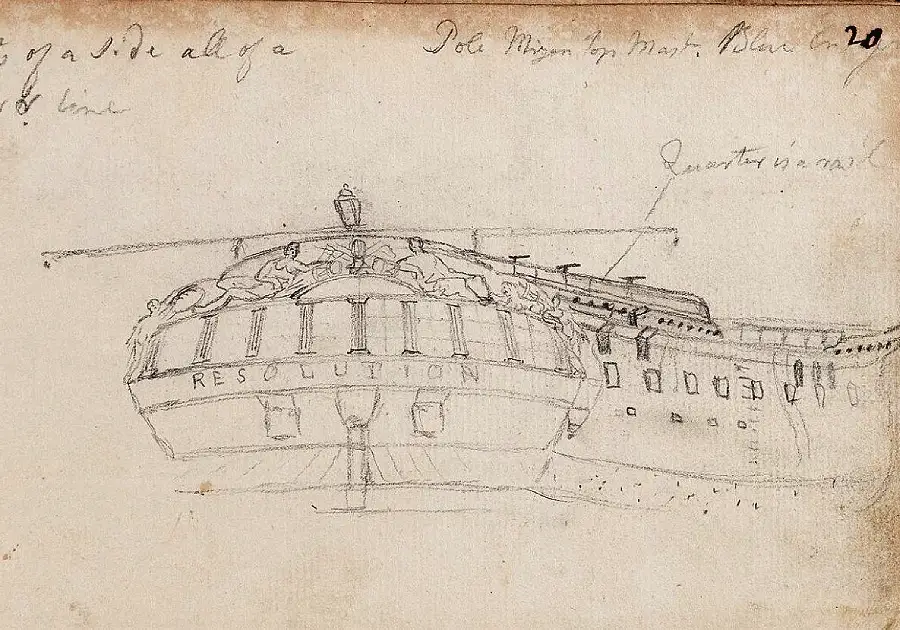
I have found some models of varying quality, plus a sketch from Thomas Luny's sketchbook of the stern, which provides some nice detail to work from. Some of the rest can be filled in by general knowledge of the period, including the rigging as outlined in books like Masting and Rigging of English Ships of War (which also covers sail making),3 how these vessels were handled from the book Seamanship in the Age of Sail (illustrated wonderfully by Mark Myers).4
When creating the background landscapes, Cook's survey maps are useful, as well as any images made by members of the ships' companies. I also fly around Google Maps to get to know the locations, comparing them to maps that show both the modern and the period names to make sure I am in the right places.
From Source to Canvas
My paintings start with a key moment and why it matters; often I look out for them when the descriptions in the journals become a little more lyrical than the usual run of notes on weather and procedure. I particularly liked Banks's description of Tahiti.
Lines like this readily prompt images in my mind. The surrounding entries in his journal and descriptions from other journals can fill in the detail or provide additional atmosphere. For example, Banks also wrote: "a large number of Canoes who traded very quietly and civily, for beads cheifly, in exchange for which they gave Cocoa nuts Bread fruit both roasted and raw some small fish and apples".5
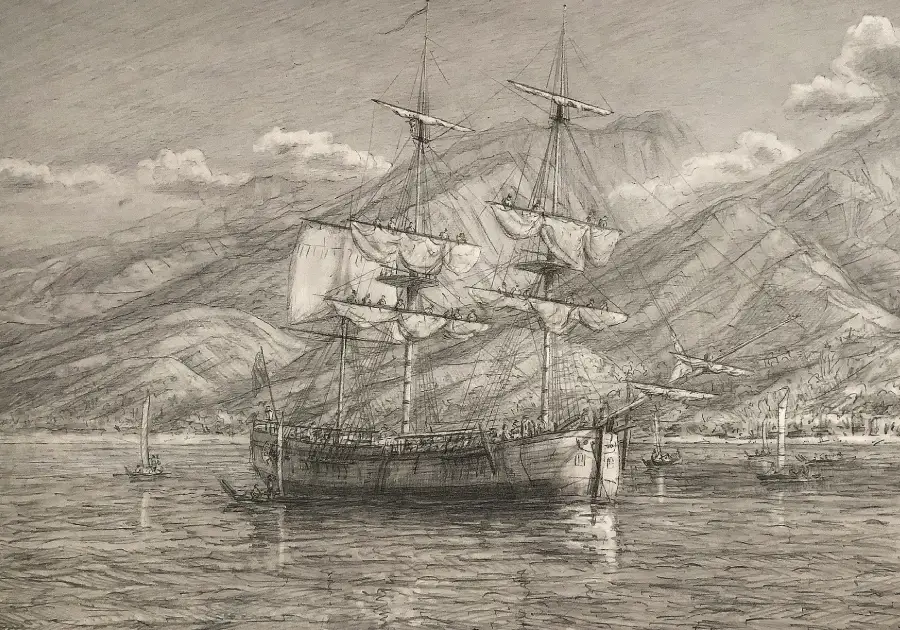
From this point, I make sketches based on my research, testing out different viewpoints and arrangements until something seems to form a strong image. Ultimately, I select a sketch to be developed into a full-size drawing — that's when I'm ready to start painting.
Building up the Painting
Different painters approach their subjects in their own way, ranging from throwing everything at the canvas at the beginning to working steadily from one corner to the other with small brushes. My approach is to build up an image in three or four layers of increasing detail, beginning with a simple version of the image, then refining colour and drawing before adding the smallest features.
The point of dread for me is always the rigging. However, the approach I take is to draw the lines faintly in pencil first so that I can remove mistakes, and have easy reference to the relevant books. Then I paint over them with thinned paint and a small brush. I get through a lot of small brushes! I have a brand of these that I really like using but they rarely keep their point for more than a single painting.
The idea is to bring together the technical drawing of a ship with a composed view of the landscape, within a consistent lighting design and atmosphere, and to communicate visually what was written in the source material. Hopefully, it gives a sense of what it was like to be there, and is also an image that can hang on a modern wall without looking out of place.
What's Next
I feel I have barely scratched the surface as far as exploration goes. I intend to carry on painting ships from several voyages and Cook's Discovery is still sitting at anchor waiting to be painted!