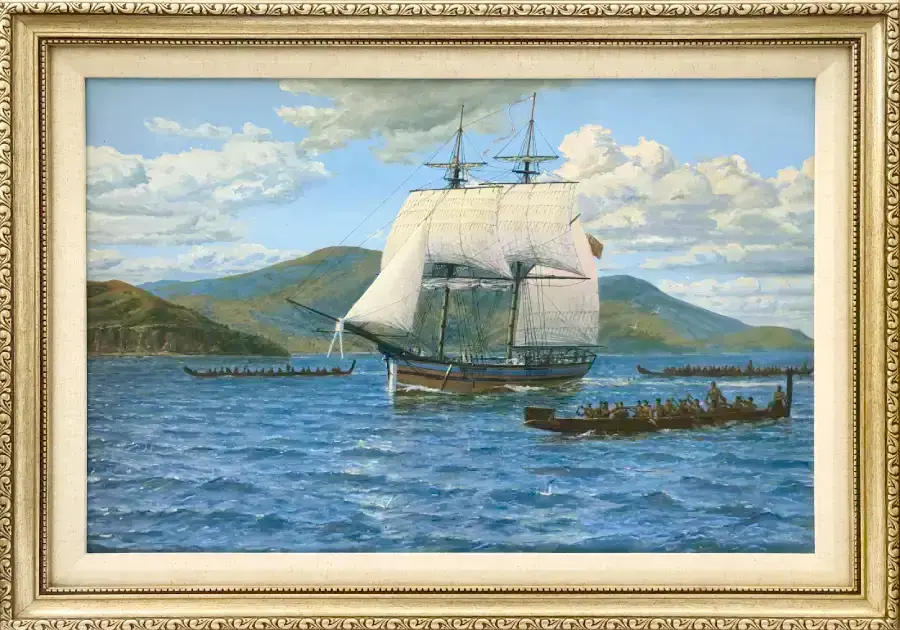
Earlier this year, I painted a view of the survey brig Lady Nelson approaching the Bay of Islands. I included an outline of the story behind this scene on the painting page, but was very pleased when Mal Riley — ex-skipper of the replica Lady Nelson — got in touch and shared the full account.
What follows is a snippet from volume three of Mal's series of books about this important vessel. It tells the story of Māori chief Te Pahi, his journey from Sydney aboard Lady Nelson, and the chain of events that followed. We pick up the story with Te Pahi himself.
Mal Riley
Te Pahi
Te Pahi (Te Paha) was thought to have been born around 1770 although this date varies in different accounts. He was a very powerful Māori Chief from the Bay of Islands area, he was a large and imposing man, over 6 feet tall. His residence or Pa (fortified village) was on what is now called Te Pahi's island in the northern part of the Bay of Islands. Whilst he spent most of his time on the mainland his island was like a castle in medieval times, a place of security and refuge for himself and his possessions.
Te Pahi had several wives, one of which he had put to death as she had a venomous tongue. He had four sons and at least three daughters. One daughter was confined to a small storehouse as she was reserved for an important marriage alliance. A newspaper report in 1954 claimed that Te Pahi had 52 children but newspaper stories tend to exaggerate.
The Flax Trade and Norfolk Island
Phillip Gidley King was the Commandant of Norfolk Island (1788–1790 and 1791–1800). One reason for the settlement on Norfolk Island was that flax plants abounded on the island. Flax is used to make linen and rope. However, this plant was New Zealand flax which was a different type of plant than the Europeans were used to and their processing methods did not work. There was talk in Sydney of getting some Māori to teach the convicts how to process the plant.
A whaling ship thought they could make some money by kidnapping two Māori men in 1793 and taking them to Norfolk Island. The whalers thought they could sell the men to King. There was a problem with their plan: the first was King would not be party to this kidnapping and secondly processing flax was women's work and the men just did not know how to do it.
The men stayed with King for six months and were treated kindly. King arranged another vessel to take them back to New Zealand, paid for from his own pocket it is said. He also gave them gifts of tools, pigs and potatoes for their chief. Potatoes then became a major food source for the Māori.
Te Pahi's Voyage to Sydney
Te Pahi, hearing of these men's travels, decided to pay King a visit on Norfolk Island and sailed on the Venus in 1805 from New Zealand. Upon arrival at Norfolk Island Te Pahi claimed that he and his party were mistreated by the captain of the Venus. King by that time had left Norfolk Island and was Governor of New South Wales. In charge of Norfolk Island was John Piper and he got Te Pahi's party onboard the Buffalo which departed Norfolk Island on October 16. From there the Buffalo went to Hobart and then on to Port Dalrymple and then on to Sydney. They encountered terrible storms which did much damage to the Buffalo's sails and rigging and caused the ship to leak 16 inches of water per hour.
Eventually Te Pahi arrived in Sydney where Governor King treated him as an honoured guest. Te Pahi and his eldest son stayed at Government House for three months. In their time in Sydney they attended church, met the who's who of Sydney and even witnessed some fighting between Indigenous people, one of whom was killed.
The Indigenous people dreaded approaching Te Pahi, maybe because of his tattoos. One of Te Pahi's sons requested a spear and was given one. Once it was in his hands all the Indigenous people took to their heels and fled. There are lots of stories floating about regarding other incidents with Te Pahi but many may be exaggerations.
The Voyage Home Aboard Lady Nelson
One thing Te Pahi did find strange was that people were executed for stealing food. King provided the Lady Nelson to take Te Pahi and his party home to New Zealand and they departed on February 25, 1806. The Lady Nelson was full of gifts given to Te Pahi, including a military coat, fruit trees, pigs, general goods and chickens. A prefabricated house frame and bricks were also in the hold and this became the first brick building in New Zealand. This building was erected on Te Pahi's island. Another gift was a metal nameplate medal.
It was a long voyage and they received some nasty weather. On March 2 the ship's log stated: "Strong gales heavy sea: found the vessel had made a great deal of water, pumped her out: found the vessel's deck leak very much". Things took a turn for the worse on March 22 — they had now been at sea for 25 days. The ship's log states: "Saturday, 22nd March. At 9 A.M. capsized boat, got the main keel up, carpenter repairing it." They made landfall at Cape Maria van Diemen (the westernmost point of New Zealand) on March 31.
On the voyage Te Pahi became ill and was nursed by George Bruce, a sailor on the Lady Nelson. Considering the other voyages Te Pahi had undertaken it probably wasn't just seasickness. Bruce and Te Pahi became firm friends and Bruce deserted upon arrival in New Zealand. Te Pahi made Bruce a Māori Chief, Bruce married one of Te Pahi's daughters and he was tattooed in Māori style including the face.
Once in the more sheltered areas of New Zealand the ship caught up with some Māori and food was exchanged. Te Pahi was still onboard on April 12 and he was angry about something. According to the ship's log he told one of the other chiefs to "go on shore and bring his men to attack the vessel". This did not happen, luckily. Exactly when Te Pahi got off the Lady Nelson is unclear but his goods were not taken to his island until April 26. The house was built on Te Pahi's island and then on May 10 Lady Nelson departed for Norfolk Island.
The Boyd Massacre
Te Pahi then features in a confusing story. Another group of Māori were visited by a ship the Commerce and there was an outbreak of disease amongst this group. They were already annoyed at the Europeans due to the introduction of this disease.
On board the Boyd coming from Sydney in December 1809 was the son of another chief, Te Ara, and he was expected to work his passage but refused to work. The captain had him flogged and denied him food. When he got home and told his people what had happened, they agreed that utu (balance/revenge) was needed. Te Ara and his brother Te Puhi sought revenge. The captain and some of the crew went with the Māori to see some trees that would be suitable for spars. This group were all killed and eaten. Later that day towards dusk the Māori went out to the ship and killed most onboard. Some crew scrambled into the rigging.
Next morning Te Pahi was said to have arrived in his war canoe and rescued the survivors but as they were taking them away more war canoes arrived and killed the survivors. The Boyd was towed towards the Māori village and ran aground on the mudflats. There the ship was ransacked. The Māori knew of guns but did not know how to make them work. They broke open some gunpowder and were experimenting with the muskets when a spark ignited the gunpowder barrels causing a massive explosion and fire. The fire ignited the whale oil onboard and the ship burnt to the waterline. The Māori then declared the wreck tapu.
There were five European survivors: a woman, two children, an apprentice and the second mate — but the second mate was subsequently killed and eaten.
Te Pahi's Death
In March 1810, European whalers encouraged by rivals of Te Pahi were convinced he led the massacre. They raided his island, destroying his brick building and other buildings and killing about 60 of Te Pahi's clan. Te Pahi escaped but later died of wounds from fighting the Māori group who attacked the Boyd. The whalers also ransacked the island and one of the things taken was Te Pahi's medal.
Reverend Marsden, convinced by accounts given to him by other Māori leaders in 1814, tried to clear Te Pahi's name. His view was that Te Pahi had been confused with Te Puhi. Marsden thought that Te Pahi had certainly been present at the time of the Boyd massacre but was not a participant.
No one knew what happened to Te Pahi's medal after the raid until in 2014 when Sotheby's auction house offered it for sale in Sydney. The medal was purchased by two New Zealand museums so it has been returned to country. Te Pahi had several wives and many children although some would have died in the wars after his death. However, there would be many Māori that would have him as an ancestor. Over 20% of living people of Māori heritage currently live in Australia.